
The Galleri Test

My primary care office has sent me the following text four times over the past three weeks:
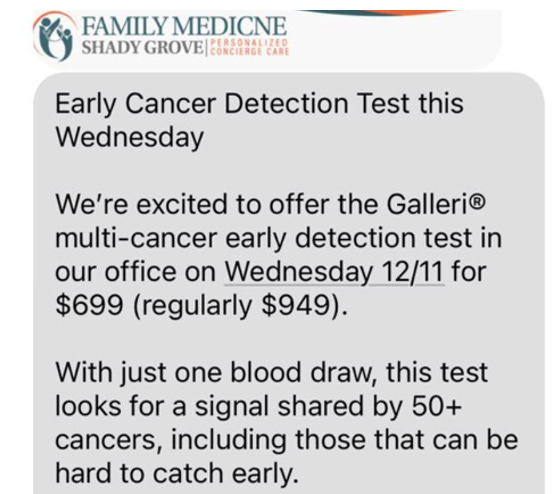
This is the first time the office has ever invited me to take a test. I have questions.
—Do they realize that Wednesday was not actually 12/11?
—Why are they pushing this test so aggressively?
—Should I take the test? Should anyone?
This newsletter focuses on the last question. Much has been written on the topic, but I’m aiming for a (somewhat) fresh perspective rather than a rehash.
As you’ll see, I’m pessimistic about the accuracy of the Galleri test and the credibility of its manufacturer, but I’ll try to be fair and provide you enough detail to decide for yourself when, if ever, the test would be worthwhile.
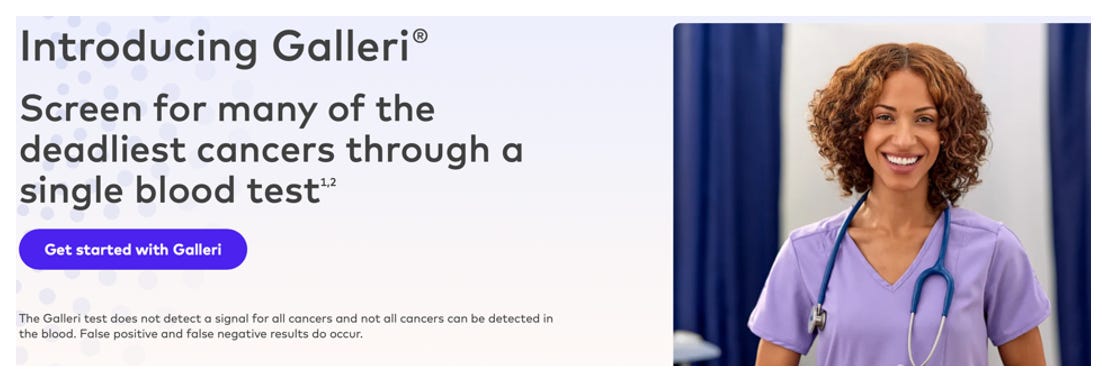
What is the Galleri test?
Galleri is the oldest and most prominent of the multi-cancer early detection blood tests available since 2021.
These tests have created a lot of buzz, owing to their supposed ability to detect many cancers early on, before symptoms appear, when treatment is most likely to succeed. For Galleri, you pay $949 (unless discounted), you do a single blood test, and two weeks later the results arrive.
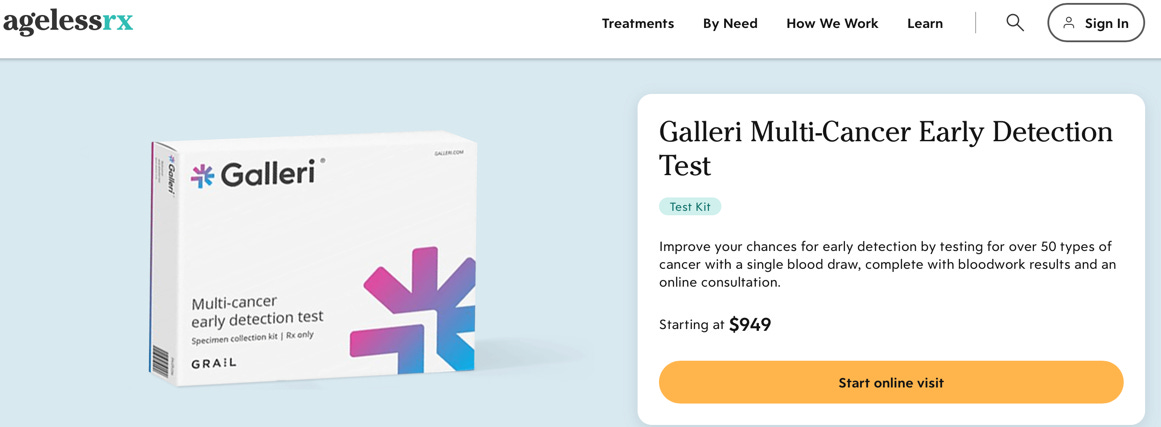
Although not FDA-approved yet, physicians can order one of these tests under the Clinical Laboratory Improvement Act. Alternatively, you can get a prescription yourself online (or just wait for your doctor’s office to start texting you).
The Galleri test relies on the fact that all cells, including cancer cells, shed fragments of DNA into the bloodstream. Galleri identifies unique DNA methylation patterns for more than 50 types of cancer and infers the location of any that it detects.
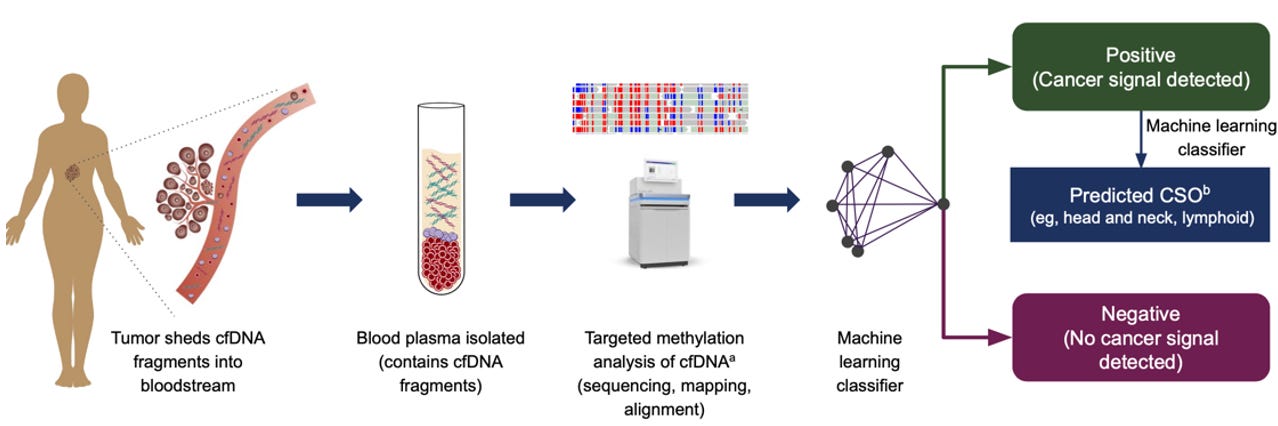
Behind the scenes, statistics play an essential role in the algorithms that detect cancer signals and their origins. But of course, the statistics that people care about most are the ones that reveal the accuracy of the test.
So, how accurate is it?
New data
Galleri made the news recently owing to a conference report at the European Society for Medical Oncology conference this October. The lead author on the report is Dr. Nima Nabavizadeh at Oregon Health & Science University, who kindly shared materials with me via email.
What made the report newsworthy is that it’s the largest study of Galleri’s accuracy to date, and the results show better performance than before.
The design of the study was simple: Galleri tests were performed on blood samples drawn from 23,161 participants. All participants were at least 50 years of age and had no recent cancer diagnosis or treatment. At some point over the next 12 months, each received a formal diagnostic evaluation for cancer.
A key finding – the one most strongly emphasized by GRAIL – is that Galleri correctly detected the presence of cancer 61.6% of the time. This is much better performance than Galleri and other screeners have shown in the past, though it does mean that 38.4% of people who tested positive turned out to be cancer-free.
Also emphasized was that 99.6% of cancer-free participants received a negative test result. By any metric this is good performance for a screener, although it means that 0.4% of cancer-free people who took the test got a false alarm.
Emphasized less, but also important, is that among the 329 participants diagnosed with cancer, the Galleri test was positive in only 40.4% of cases. This means that the test missed early-stage cancers 59.6% the time.
Among the positive tests that were accurate, the location of the cancer was correctly identified 91.7% of the time.
How should we interpret the accuracy data?
Reactions to Galleri testing range from passionate support to outright hostility. Helpful discussions of the various perspectives can be found in this December New York Times article and this December Skeptical Cardiologist post.
How favorably people view the Galleri test depends mainly on whether they treat the accuracy data in relative or absolute terms.
Relatively speaking, Galleri seems to outperform other early-stage cancer screenings, at least for some cancers among people over 50 or otherwise at risk, and it identifies some cancers for which there aren’t established screening methods. This is the most positive thing that can be said about the test, but it’s heavily qualified praise. Galleri doesn’t perform as well as conventional screening at identifying cancers of the breast, prostate, uterus, thyroid, bladder, kidney, and others.
Relatively good performance is what GRAIL and other Galleri supporters are pushing. But as a test-taker, you don’t necessarily want something that’s relatively accurate. You want something that’s accurate, period.
Here’s where the dark clouds start to gather. In absolute terms, Galleri’s success is limited at best. Let’s revisit the new data through this lens:
38.4% of people who tested positive didn’t have cancer. And, 0.4% of cancer-free people who took the test got a positive result.
These false alarms would make people anxious. Time and money would be wasted on unnecessary additional testing and/or treatment.
59.6% of people who had cancer tested negative. They were falsely reassured of being cancer-free.
Here one might be tempted to say: This is unfortunate, but it’s not a strike against Galleri. These people have early-stage cancers that other screeners would’ve missed too, if screeners even exist for those cancers. But we don’t want to risk complacency. When the first symptoms do appear, or when it’s time for a regularly scheduled exam, we don’t want these people saying oh, the Galleri test already told me I’m fine.
Credibility issues
GRAIL is no Theranos, but the company is marketing Galleri aggressively at home and abroad, and it has already spent millions of dollars lobbying for the test to be covered under Medicare – efforts that began when the accuracy data were even weaker than what we see in the new report.
These data are all “in-house”, meaning that the research has been exclusively conducted and disseminated by GRAIL employees or affiliates. (Dr. Nabavizadeh, lead author of the new report, is a member of GRAIL’s advisory board.) This in itself is not unusual, but GRAIL has not shared protocols and data as openly as other manufacturers routinely do at this stage of development. And, there have been legal hiccups, including a class action lawsuit in the U.S. alleging misleading statements about the accuracy of the test, as well as allegations by at least one expert of being fired by GRAIL for airing concerns about the use of early detection data.
One of those concerns is the prospect of overtreatment, given that some cancers are unlikely to cause harm or may be destroyed by the immune system, while others may be lethal regardless of how early they’re detected. These are cases where detecting and treating early-stage cancer is not necessarily desirable, an issue GRAIL rarely addresses in its push to expand Galleri sales.
Bottom line
If you don’t have cancer but are over 50 or otherwise at risk (e.g., due to family history or lifestyle), the Galleri test might accurately catch an early-stage cancer or reassure you, accurately, that you’re cancer-free. But it’s also reasonably likely that the test would fail to detect the presence of cancer, result in a false alarm, or identify a cancer that needn’t be treated.
What many of us are left with is a choice between two less-than-ideal options: Take the test knowing the results have more than a trivial chance of being inaccurate, or skip the test knowing that you’re missing out on results that have more than a trivial chance of being accurate and therefore useful.
I won’t be taking the Galleri test. I have too many concerns about the test’s accuracy and the manufacturer’s credibility.
Fortunately for me, that non-existent date Wednesday, December 11, 2025 has passed, and my doctor’s office will stop inviting me to take the test. Hopefully they show this much persistence with other aspects of patient care.
Thanks for reading!
As our research team have and hope to continue working with Grail I am particularly interested in this (I have no financial ties to grail btw). The sensitivity is poor for stage 1-2 cancer and thus probably means it will fail in the big RCT. On the other hand we think it could help diagnose symptomatic patients especially those with vague symptoms. There are of course plenty of other companies snapping at Grails feet now, including a test developed by iur colleagues in oncology.
Interesting, this company was mentioned in my August '24 edition, https://jkd0811.substack.com/p/its-saturday-at-the-petri-dish
Galleri promises to detect multiple cancers—but new
evidence casts doubt on this much hyped blood test
https://www.bmj.com/content/386/bmj.q1706
Also, I am going to put this on the same level as those whole body MRI.
from https://www.verywellhealth.com/prenuvo-full-body-mri-scan-7693049
• Prenuvo offers a full-body MRI screening service that can detect 500 conditions.
• Radiologists say they usually only recommend MRI scans for patients who have a family history of cancer and only on a case-by-case basis.
• Although MRI scans are useful in detecting abnormalities in the body, they can also create anxiety in patients and sometimes lead to unnecessary procedures.
I would also question if your PCP's Clinic getting remunerations to advertise this service. If there was a need to it, they would have arrange for the labs.
I also question your choice of PCP. ;~) I would if it was mine.