
The Ultraprocessed Food Debate


Why are ultraprocessed foods (UPFs) unhealthy?
One Dorito or sip of Coke is unlikely to hurt you. The question is why more frequent consumption of UPFs has been linked to weight gain and increased risk of cardiometabolic diseases, cancer, dementia, and more.
Scientists agree that nutritional profiles are partly to blame. UPFs often contain too much salt, fat, and/or sugar, without providing much nutritional value.
For instance, two original Twinkies (i.e., one serving) contain 280 calories, more than 10% of what most adults need for the day, as well as 16% of the recommended amount of sodium, 20% of the saturated fat, and 62% of the added sugars. That’s pretty much it for nutrients.
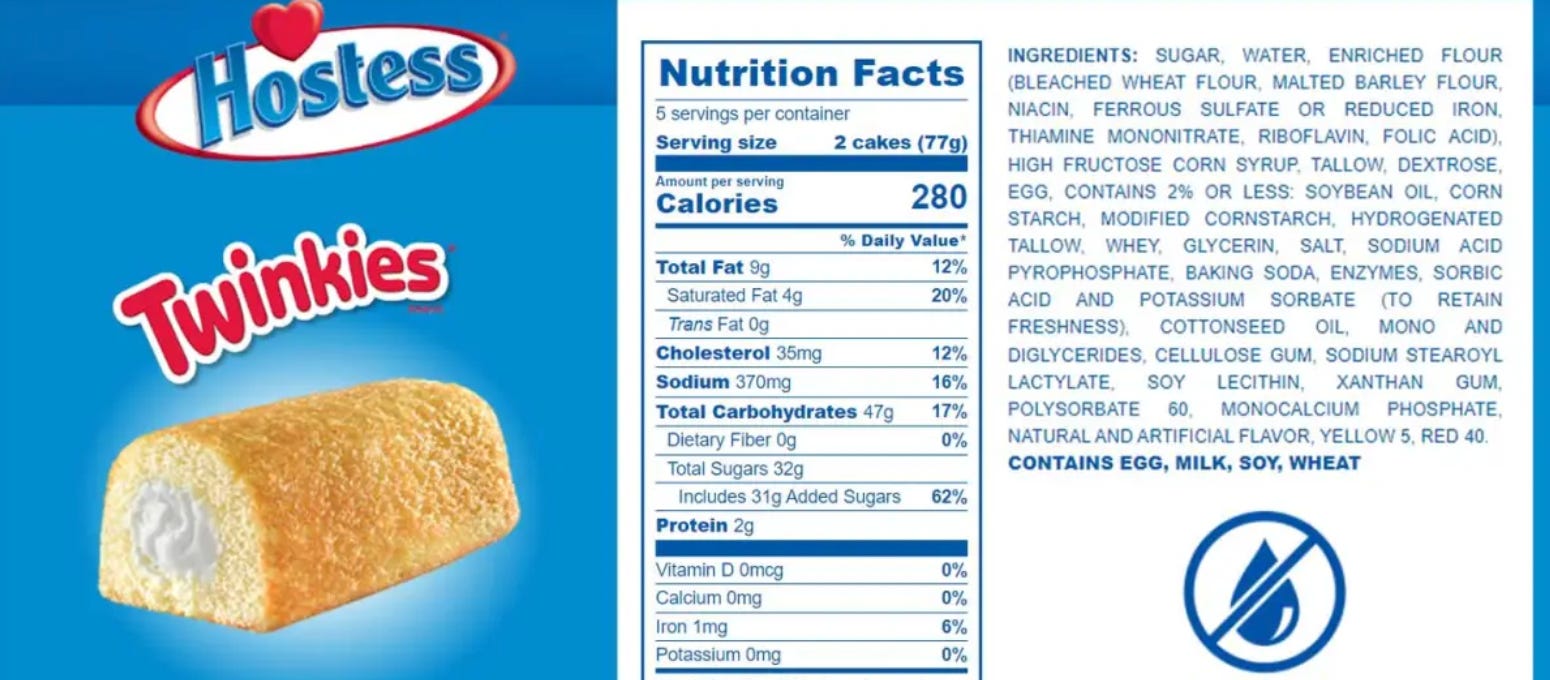
Experts would agree that nutritional profiles like this contribute to the unhealthiness of UPFs. What they disagree about is how much UPF processing also contributes.
The debate
This newsletter differs somewhat from my usual posts. Instead of focusing on a recent study, I want to share an overview of the nutritional profile vs. processing debate. I will touch on some new studies, as well as a new commentary, but my goal is to tease out some of the practical implications of the debate.
In the Appendix I provide a definition of ultraprocessed food. The nutritional profile explanation for UPF unhealthiness is pretty straightforward. If you trust mainstream dietary recommendations, it’s easy to see from nutrition labels why eating too much UPF creates health risks without being very nourishing.
The notion that processing effects also contribute is a little more complicated, because it covers more ground. Here’s how I think about it: Processing effects mainly encompass destruction, construction, and addition.
1. Destruction: UPF processing often destroys the matrix, or natural structure of whole foods.
UPFs are created by industrial processes like milling, refining, and extrusion that break down whole foods into isolated ingredients.
This is problematic because, digestively speaking, the whole does not equal the sum of the parts.
For instance, the starch in whole grains is ordinarily packed into cells and slowly released during digestion. But Twinkies are made of wheat flour so highly refined that little remains other than starch, and malted barley flour is added to partly hydrolyze it. The resulting material is digested so rapidly that it’s mostly absorbed in the upper gut, before it can reach the ileum – a part of the small intestine that’s highly active in releasing GLP-1 and other hormones that signal fullness and regulate blood sugar.
The result is that your blood sugar spikes, but you may keep eating the Twinkies without feeling full. (And later, when your blood sugar declines, you might crave Twinkies again.) In some respects, what happens is the opposite of what drugs like Ozempic do. Ozempic activates GLP-1 receptors, creating a sense of satiety, while UPFs reduce GLP-1 signaling.
2. Construction: UPF processing creates sensory qualities that promote overconsumption.
Efforts to make UPFs irresistible are the stuff of legend. I highly recommend the 2013 bestseller “Salt, Sugar, Fat: How the Food Giants Hooked Us” for a peek behind the curtain.
What makes UPFs so delicious? The nutritional profiles of course, as we’ve evolved a natural preference for salty, fatty, and sugary flavors. But we can also thank (or curse) food scientists for creating experiences like bliss points and vanishing caloric density.
I imagine you’re familiar with these experiences, even if you don’t recognize the terms.
A bliss point is the precise combination of salt, fat, and sugar that maximizes the pleasure of eating a particular food. In the case of Twinkies, the bliss point is amplified by their mouthfeel – the contrast between the soft, creamy center and the spongy cake. (I apologize if this is making you crave one. Having been addicted to them in middle school, I can assure you they’re awful.)
Vanishing caloric density refers to the way a food product quickly dissolves in your mouth. Cheetos, Pringles, and cotton candy are classic examples. The sensation is delightful, but it also reduces chewing time and undermines your brain’s ability to register how much you’re eating, thereby exacerbating the signaling problem I described earlier.
Food scientists also make UPFs more desirable by staving off certain experiences, particularly sensory-specific satiety. This refers to the way satisfaction decreases as we eat the same food, with little impact on our appetite for other flavors or foods. You’ve finished dinner, you’re full, but now dessert sounds tempting.
Food scientists leverage sensory-specific satiety by creating UPFs that don’t yield simple, stable flavor profiles. Doritos are famous for their complex mix of salty, acidic, and fatty flavors, and the crunch helps delay sensory-specific satiety. (I would open a bag and share a more nuanced description, but I was addicted to them too in middle school and I don’t want to fall off the wagon.)
UPFs have been described as “hyperpalatable” – engineered to be so delicious we crave them even when we’re not hungry. In recent years, some scientists have been proposing the stronger term “addictive”. They’re not speaking metaphorically. Studies have shown that UPFs create addiction-like effects at the behavioral level (bingeing, craving, tolerance, and withdrawal) as well as physiologically (e.g., dopamine spikes after eating UPFs, followed by a blunting of the dopamine response that spurs cravings for more).
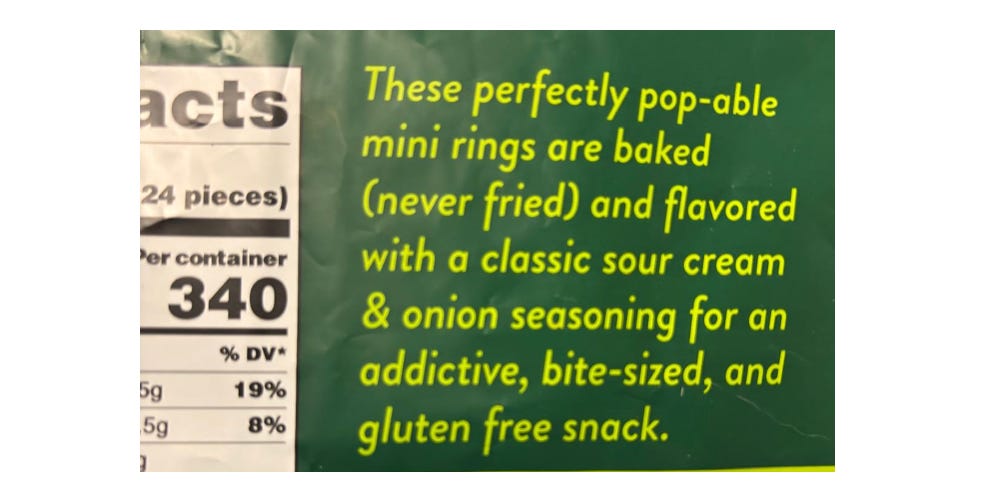
Ironically, UPF manufacturers, at least for now, don’t shy away from references to addiction on their packaging. Here’s a typical one, from Trader Joe’s Sour Cream and Onion Flavored Rings (340 calories per 2.5 ounces; 20% of the recommended daily value of sodium):
3. Addition: UPFs processing introduces additives and byproducts.
Food additives help make eating UPFs pleasurable, but they’re also critical for preventing spoilage, staleness, separation of ingredients, etc. These aren’t secondary considerations. In 2013 alone, the manufacturers of Twinkies spent millions of dollars on improving shelf life. (According to a meme I learned as a kid, Twinkies never spoil, but the shelf life is actually around 45 days.)
Though food additives must be FDA-approved or generally recognized as safe (GRAS), the regulations don’t always keep up with the science. For instance, processed meats are widely recognized as carcinogenic, and there’s evidence that the nitrites they contain are one contributor.
As for Twinkies, one of their main preservatives, potassium sorbate, was linked to type 2 diabetes, hypertension, and cancer in separate articles published by a French team earlier this year. The data comes from the Nutrinet-Santé cohort, and I have methodological concerns (see here), but still, the health risks posed by UPFs don’t seem to be limited to just one product or ingredient.
Take bacon, which might be called a poster child for the potential dangers of these products. The curing process introduces nitrites. Smoking adds polycyclic aromatic hydrocarbons (PAHs), chemicals that may be carcinogenic, and cooking bacon creates new PAHs as well as other potential carcinogens (HCAs and, under some conditions, nitrosamines). Meanwhile, per calorie, bacon is heavily larded with salt and saturated fat.
The point is not that if you eat bacon on occasion, you’ll get cancer. No study tells us that. Rather, the research shows that eating bacon exposes us to substances that increase the risk of cancer if we eat enough of it.
I wish I could define “enough”, but I can’t, and you shouldn’t trust anyone who does. Large quantities of nitrites etc. cause cancer in lab rats. People who eat the most bacon and other processed meats have higher rates of colorectal cancers (and other health problems), and we have reasons to assume a causal link. But (a) we can’t say exactly how much bacon per week or year increases risk, and (b) the risks are calculated for group data. You’re not a group.
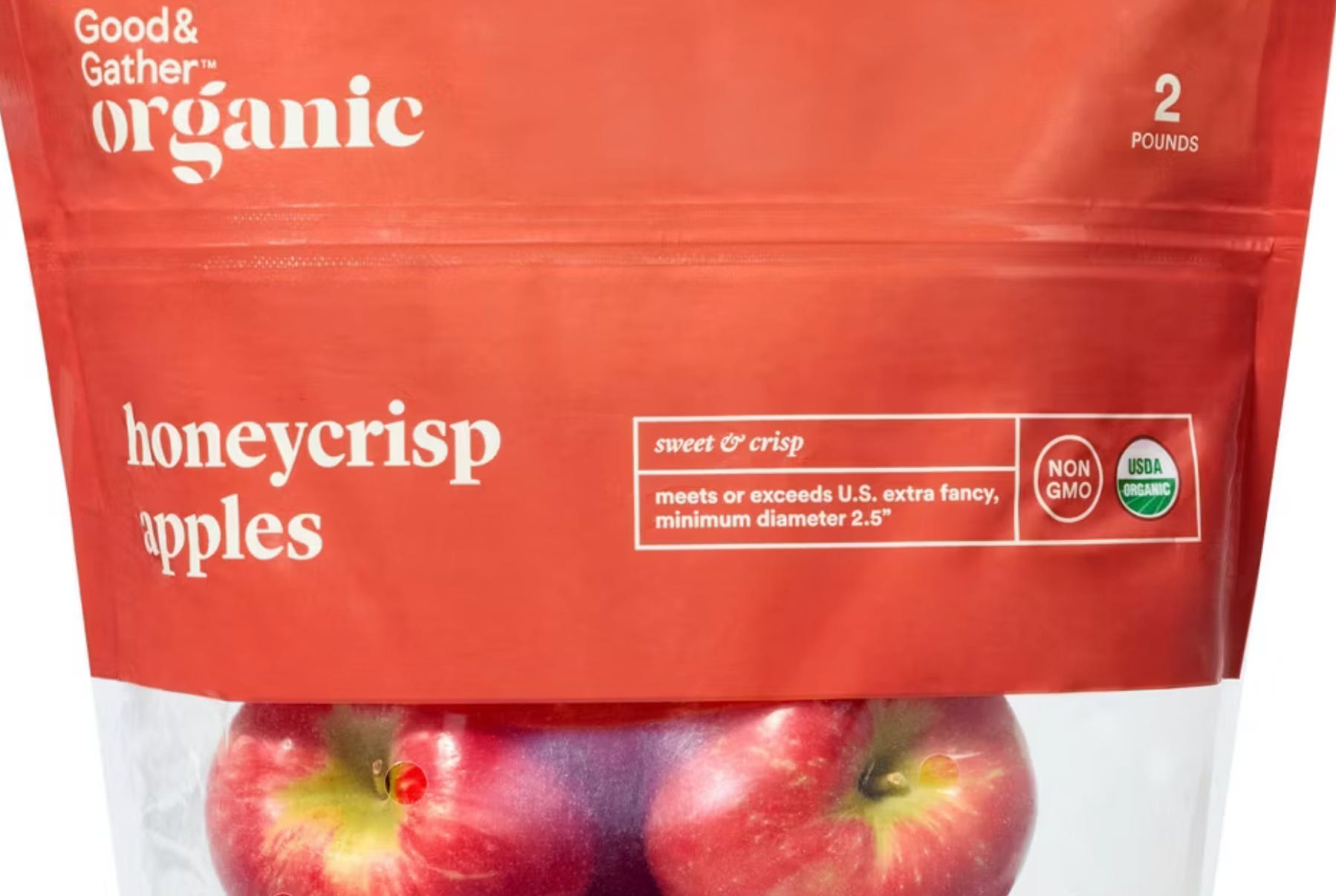
UPFs have also been maligned for contaminants (obtained through contact with packaging, for instance) and for being marketed in ways that promote overconsumption. I think we should be concerned about these things, but they’re not specific to UPFs. After all, a bag of fresh apples might be contaminated by microplastics and plastic additives, and the bag might sport incentives to eat more apples (e.g., the one below is labeled “sweet & crisp”, “meets or exceeds U.S. extra fancy”, “Non GMO, and “USDA Organic”).
Why should we care?
So far, I’ve said three things:
1. UPFs tend to be unhealthy. A 2024 review of 45 meta-analyses linked UPF consumption to 32 different health conditions, and the evidence of harmfulness is growing by the day.
I mean that literally, by the way. A JAMA Network study published just yesterday suggests that people who drink too many sugar-sweetened beverages have an increased risk of liver cancer. No effects were found for artificially-sweetened drinks, though these sweeteners have been linked to chronic conditions in a few but by no means all observational studies.
2. One reason UPFs tend to be unhealthy is their nutritional profiles. Depending on product, they may contain too much salt, fat, and/or sugar, while not necessarily providing much nutritional value.
3. Scientists disagree about how much UPF processing contributes to their unhealthiness, over and above nutritional profiles. Known processing effects include unfavorable metabolic responses (e.g., blood sugar spikes), overconsumption, and exposure to unhealthy additives and byproducts.
In theory, you could ignore everything but point #1, and just change your diet. Skip the Twinkies. Skip the burgers and bacon and chips and sodas. Even skip some of the UPFs that look healthy until you read nutrition labels (e.g., A single MET-Rx gluten-free meal replacement bar provides 400 calories, or roughly 20% of what many people need per day, along with 40% of the recommended daily value for saturated fat and 44% of the value for sugar.)
But it’s increasingly difficult to avoid UPFs altogether. On average, nearly 60% of the calories in American diet come from ultraprocessed foods – the highest percentage in the world (see figure below; source). This is widely considered one reason our rates of obesity, type 2 diabetes, and other chronic health problems are higher than those of most industrialized countries, even though we spend more per capita on health care.
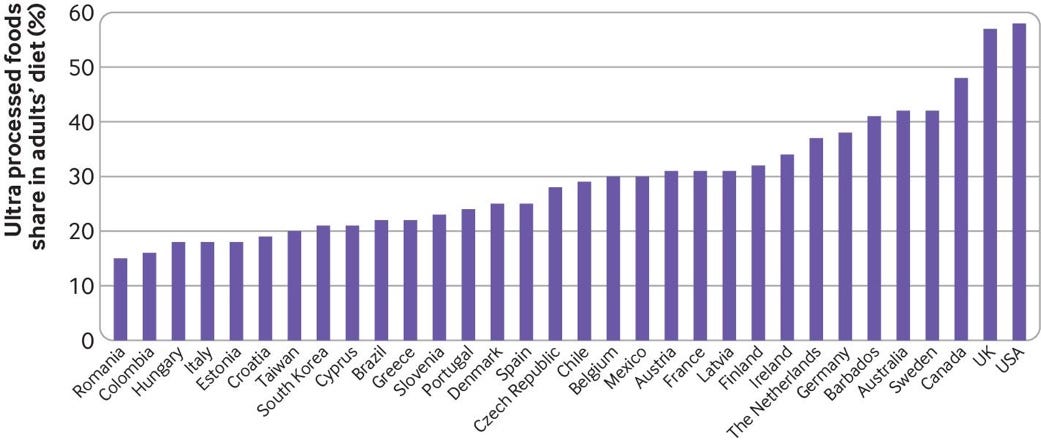
UPFs wouldn’t be a public health problem if people radically changed their diets, but a more realistic approach to the problem calls for more modest goals.
But why would anyone but a scientist care about the UPF debate? If consumers recognize that most UPFs are unhealthy, do they need to know why?
Absolutely.
If nutritional profiles are the sole culprit, we can read nutrition labels carefully, scaling back on the clearly unhealthy stuff (e.g., one ounce of a Hershey’s milk chocolate bar – one big bite – contains just over a quarter of the saturated fat and sugar most people need in a day), or choosing healthier versions of the same UPF (that is, a lower salt, fat, and/or sugar version, although you’ll often find that when a brand reduces one of these nutrients, they increase another one to maintain palatability).
Regardless of how the UPF debate turns out, I think it’s worth keeping an eye on nutrition labels (though not obsessing about them), and we should avoid or minimize consumption of products containing additives such as nitrites and, perhaps, certain preservatives. But I also happen to believe that, on balance, the evidence favors the processing view. To the extent that view is accurate, we need additional strategies.
Most important would be to remember that UPFs are engineered to increase cravings and consumption. You might want to buy less of them – if they’re not on your shelf, they can’t be eaten – and when you do partake, try to remain mindful of how much you’re eating, since your brain’s capacity to register fullness is being short-circuited. Try to eat slowly, in order to minimize the blood sugar spikes. And, of course, aim for a healthy diet overall.
I’ve noted that I favor the processing view, and so I want to address a new commentary that argues against it. This commentary was published in one of the world’s leading scientific journals, so we can expect that lots of folks, including medical professionals and nutritionists, will be pondering what’s written there.

A new commentary
This short paper, led by Faidon Magkos (University of Copenhagen) was published in Science on June 4.
Magkos and colleagues argue that evidence for UPF processing effects is actually weak. They reviewed five RCTs showing that UPFs create problems such as overconsumption and weight gain. In each case, they argue, the effects can be explained by the textures and nutritional profiles of the UPFs.
For instance, participants in these studies tended to eat more UPFs than the healthier foods available to them. Magkos and colleagues attributed this to the softer textures of the UPF diets, under the assumption that softness prompts greater intake. If hard-textured UPFs had been offered, participants wouldn’t have eaten as much.
As for weight gain, even when the UPF and non-UPF diets were calorically identical, participants gained more weight on the UPF diets. Magkos and colleagues claimed this is because the UPF diets were lower in fiber but higher in sodium. As a result, people were retaining more poop and more fluid, respectively.
I think these are reasonable criticisms of the five RCTs, but they seem like an awfully narrow basis for the broad conclusion that the available data provides “weak support for an ultraprocessing-specific effect of UPFs on body weight regulation and cardiometabolic function”.
After all, not all UPFs are soft (think of crispy bacon, beef jerky, crackers, Cap’n Crunch, and Cheetos – at least for that split second before they melt). And, the RCTs in question don’t consider additives, byproducts, or long-term effects. To the extent that isolated ingredients have metabolic impacts, such as blood sugar spikes, the damage is likely to accumulate over time. An additional consideration is that dozens of observational studies, though far from perfect, corroborate the processing view.
In the end, I believe that the value of Magkos and colleagues’ paper is in demonstrating how tricky it is to interpret nutritional impact data, even when it comes from tightly-controlled RCTs. But I don’t think processing effects are ruled out. Rather, these effects just keep cropping up. In a June 3 study in American Journal of Public Health (which I had considered reviewing here before this post became so long), researchers reported dose-response associations between UPF intake and outcomes such as poorer metabolic health, diabetes, and cancer. These associations remained significant even after adjusting for the nutritional quality of UPFs people were eating.
What should we do?
“Eat food. Not too much. Mostly plants.“ (Michael Pollan, 2006.)
If succinctness counts, that famous line from The Omnivore’s Dilemma might be the best nutritional advice you’ll ever see. “Eat food”, in effect, means “don’t eat most UPFs”, because what Pollan calls food tends to be whole or minimally processed.
At the same time, a bit more needs to be said. We eat UPFs because we enjoy them, or they alleviate stress, or we think we’re too busy to cook from scratch. What should we do when we can’t quite live up to Pollan’s standards?
I’m sure I’ll never eat another Twinkie, but I’m reluctant to give up ice cream. What I do instead (though not consistently) is to read nutrition labels and avoid brands that contain emulsifiers, stabilizers, and other additives – including, in some cases, UPFs (e.g., Breyer’s Cookies & Cream, which boasts of being “loaded” with creme-filled chocolate cookie pieces.)

On the other hand, Häagen-Dazs makes products that can be described as processed rather than ultraprocessed (see Appendix). Häagen-Dazs Vanilla consists of just five ingredients – cream, skim milk, sugar, egg yolks, and vanilla extract. Though it has way too much sugar and saturated fat, I’m convinced that if I live healthy and eat well, enjoying small portions every now and then won’t hurt. (So far, so good…)
Eat food. Not too much. Mostly plants. And enjoy yourself.
Thanks for reading!
Appendix: What is an ultraprocessed food?
Back in 2009, the Brazilian scientist Carlos Monteiro was the first to use the term “ultraprocessed food” in an academic paper. Along with his colleagues, Monteiro developed the NOVA classification system for foods. NOVA is not the only system, but it remains the one most widely used among nutrition researchers.
The NOVA system classifies foods according to the nature, extent, and purpose of food processing:
Group 1: Unprocessed or minimally processed foods (fresh produce, meat, dairy, oats, dried beans, etc.).
Group 2: Processed food ingredients (oils, flours, sugar, salt, etc.).
Group 3: Processed foods (combinations of group 1 and 2 – traditional breads, cheeses, some canned foods, etc.).
Group 4: Ultraprocessed foods (UPFs).
In the NOVA system, UPFs are defined as industrially manufactured products that contain little or no group 1 food, and rely on ingredients you wouldn’t find in a home kitchen. They’re designed for maximum shelf life, convenience, palatability, and consumption.
From this definition you can see that a Twinkie is clearly ultraprocessed, whereas something like ice cream or yogurt could represent more than one group depending on how they’re produced. Plain yogurt made from a bacterial culture would be a group 1 food. Add a little sugar and/or fruit and it becomes group 3. But grocery stores carry a number of group 4 yogurts that contain additives such as artificial sweeteners, flavorings, starches, emulsifiers, etc.
Ken, see you wading into some deep waters here. Thanks for this look and I still question the NOVA system usefullness. Seems is really an overly simple classification of a complex area. I prefer the "junk" food classification which are the sugar, salt, saturated fats, no nutritional value "edibles." I find this helpful. https://www.cambridge.org/core/journals/proceedings-of-the-nutrition-society/article/are-all-ultraprocessed-foods-bad-a-critical-review-of-the-nova-classification-system/16D07B81A1587340B3EE847F3C662E60
Not everything in group 4 is automatically bad.
So, are all "natural" dietary supply under the NOVA Group 4: Ultraprocessed foods (UPFs) ? ;)