


Here’s a simple question: How do you know if you’re too heavy?
No doubt some TikTok influencer or tactless relative has opinions to share, but I’m not asking about how you look in a swimsuit. The question is how you determine whether excess weight may be undermining your health.
“The most reliable way to know”, according to Claude AI, “is a conversation with a doctor, who can look at your whole picture...rather than just a number.”
Claude is alluding to an ideal world in which you and a health care provider take a holistic approach, evaluating your blood pressure, blood glucose, lipids, medical history, daily functioning, and much more, before deciding whether your weight is a concern.
In the real world, Claude’s advice is not necessarily heeded. As Jerry Muller discusses in The Tyranny of Metrics (2018), we tend to fixate on single numbers – college rankings, standardized test scores, credit ratings, etc. – at the expense of deeper, more holistic judgments. A particularly good example is the BMI, which expresses a person’s weight relative to their height (specifically, weight in kilograms divided by height in centimeters squared).
It’s hard to exaggerate the prevalence of the BMI as a personal health metric. Your primary and specialty care medical records almost surely include it. Health organizations like the WHO, the CDC, and the NIH advise you to monitor it, as do gyms, wellness programs, and SkinnyTok influencers. Insurers use BMI thresholds to determine whether they’ll cover treatments such as GLP-1s. In many contexts, the answer to the question “How do you know if you’re too heavy?” is, in effect: “Check your BMI.”
Unfortunately, the BMI is a flawed metric. We’ve known this for decades, but a mix of institutional inertia, reimbursement incentives, and sheer convenience keep it prominent in health care and the wellness industry.
What makes BMI so appealing is that it’s a simple, noninvasive proxy for adiposity, or body fat. Excess visceral fat – the kind that’s deep inside the abdomen and surrounds internal organs –disrupts metabolic functioning in many ways that increase risk of cardiovascular disease and other health problems. How sweet it seems to measure a person’s height and weight, run a simple calculation, and immediately know whether their adiposity gives cause for concern.
However, confidence about the BMI’s ability to do that continues to falter. Since 2023, the American Medical Association (AMA) and other groups have formally advised against reliance on this metric as a stand-alone measure of adiposity. In the spirit of that advice, a study published last week showed that measures of waist circumference (WC) and waist-hip ratio (WHR), combined with the BMI, improve the ability to predict cardiovascular risk.
I was intrigued by this study. How useful could it be to deploy three simple measures of adiposity as opposed to just one? Could doing so actually help identify whether a person is heavier than they should be? Or, would using three metrics simply multiply the problem of what Jerry Muller calls “metric fixation” and divert attention from more thoughtful judgment?
In this newsletter I want to discuss three topics:
1. What’s wrong with the BMI?
2. Should the BMI be supplemented by adiposity metrics such as the WC and WHR?
3. When should a person consider themselves too heavy?
1. What’s wrong with the BMI?
(Parts of this section are folded in from one of my earlier posts.)
The body mass index, or BMI, equals a person’s weight divided by the square of their height. In the metric system (height in meters, weight in kilograms), the standard formula is:

In the English system (height in inches, weight in pounds), a conversion factor must be added:

For example, if you’re 5 feet 4 inches tall and weigh 140 pounds, your BMI would be: 140/(64 x 64) x 703 = 24.03. Online calculators are freely available.
It’s easy to see why the BMI has become so popular: It’s simple, cheap, and non-invasive, and because calculation is needed, it feels a little “science-y”. In clinical practice as well as research the scores are routinely categorized as follows:
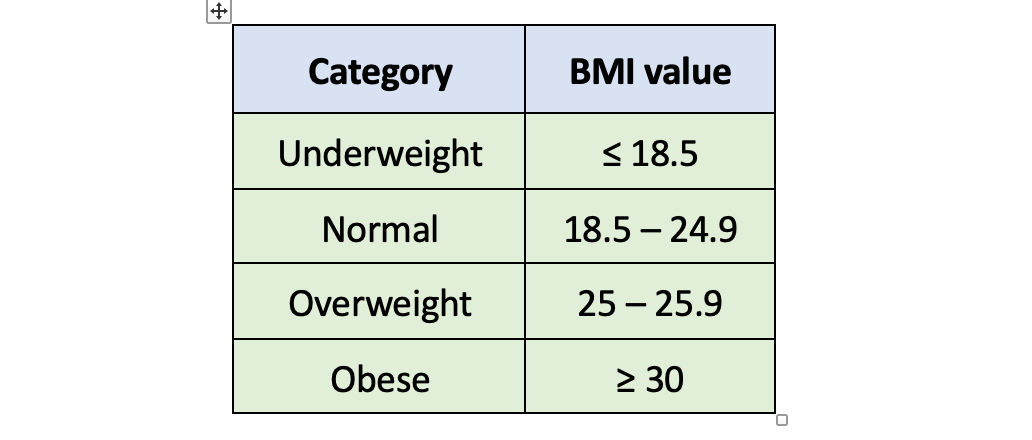
Experts disagree about how to adjust these boundaries according to age, sex, and ethnicity, but categorization is common, and that alone is problematic.
For instance, the difference between a BMI of 24.8 versus 25.2 is negligible, but only the latter is considered “overweight”, and it might trigger different advice from a health care provider, higher life insurance premiums, and lower discounts on employer-sponsored wellness programs – not to mention anxiety about weight.
What else is wrong with the BMI?
In a word, misclassification. Here are three reasons:
The BMI doesn’t reflect how fat is distributed. A person with a BMI in the normal range might have a lot of “belly fat”, including the visceral fat that increases the risk of cardiovascular disease and other health problems.
The BMI makes no distinction between fat and muscle. Since muscle is roughly 18% denser than fat, the BMI tends to misclassify relatively muscular people as overweight or obese, while underestimating the extent of adiposity among people with relatively low muscle and bone density.
The formula for BMI, which squares height in the denominator, creates overestimates for especially tall people and underestimates for especially short ones.
These limitations are illustrated by a pair of famous athletes:

At the peak of his career, Arnold Schwarzenegger was 6’ 2” and 235 pounds. This corresponds to a BMI of 30.2 and therefore a classification of “obese”. As a professional bodybuilder, however, his body fat would’ve been extremely low.
At the other end of the spectrum is the Olympic medalist Sha’Carri Richardson. Sprinters have fairly low body fat, and so their BMIs usually fall within the “normal” range. Richardson is an exception because she’s relatively short. At 5’ 1” and 99 pounds, her BMI is 18.7, or borderline underweight. As with Schwarzenegger, this illustrates a problem with the BMI rather than with her weight.
Misclassification is not limited to special cases. A 2016 study of over 40,000 adults found that 31% of those with normal-range BMIs were metabolically unhealthy with respect to measures such as blood pressure, cholesterol, serum glucose, and insulin resistance. At the same time, roughly half of “overweight” people, and 16% of those classified as “obese”, were metabolically healthy.
In short, the BMI may be a source of false reassurance or needless anxiety.
2. Should the BMI be supplemented by adiposity metrics such as the WC and WHR?
Excess weight can create a variety of health problems, including extra stress on the joints, but the main concerns pertain to adiposity. So, why not measure body fat more directly, as opposed to relying on metrics such as the BMI?
If you have enough money and time, you could get adiposity estimates via technical procedures such as hydrostatic weighing or dual-energy x-ray absorptiometry, but these estimates vary from one procedure to the next, and it’s hard to translate them into clinically-relevant cut-offs (like the BMI categories).
Alternatively, you could pinch yourself. Body fat can be estimated with calipers (available on Amazon, of course), but the actual measurement procedure is more complicated than just a pinch, and, after applying a complex formula, what you end up with is still no more than an estimate.
This leaves us with conveniences such as the BMI, the Body Roundness Index (BRI), which I review here, as well as a host of other adiposity metrics. These include waist circumference (WC) and waist-hip ratio (WHR), which are explored in the new study and, like the BMI, can be calculated at home.
The simplicity of these metrics increases their allure, given that medical professionals are often pressed for time, telemedicine is increasingly popular, and at least some people enjoy tracking personal health data (there are smart phone apps dedicated to BMI, WC, and WHR, for instance). But how informative are these metrics?

New evidence
The new study, led by Zeina Dardari (Johns Hopkins; Indiana University), was published online on August 11 in the Journal of the American College of Cardiology (JACC).
Dardari and colleagues combined data on 259,351 adults from 15 CCC cohorts. Participants in these studies were tracked for a median of 20 years with a focus on who would develop one or more of eight cardiovascular outcomes, as well as all-cause mortality. (The cardiovascular outcomes were heart attack, stroke, heart failure, atrial fibrillation, total coronary heart disease, total cardiovascular disease, coronary heart disease, and cardiovascular disease.)
The researchers controlled for the effects of demographics (age, sex, race/ethnicity, and education), health behaviors such as smoking and alcohol use, preexisting conditions (diabetes, hypertension, and hyperlipidemia), and relevant medication use.
The three key predictors were BMI, waist circumference (WC), and waist-hip ratio (WHR).
This all sounds quite objective, but...where exactly is your waist?
As I mentioned, the researchers obtained data from 15 different cohorts. In some cohorts, the navel was assumed to mark waistline. In other cohorts, “waist” was defined as the midpoint between the lowest edge of the ribcage and the iliac crest (the uppermost edge of the hip bone). Other methods were used as well. I mention this by way of pointing out that a small amount of measurement error was baked into Dardari and colleagues’ data. (Hip measurements were less prone to error – the measuring tape was wrapped around the “maximum gluteal protrusion”, which is, um, exactly what it sounds like.)
For this study, participants were classified as high vs. low in WC and in WHR, with “high” indicating elevated risk of cardiovascular disease according to WHO and NHLBI reviews of the literature. Here are the cut-offs:

You wouldn’t expect WC and WHR to be perfect, given discrete cut-off values (ceteris paribus, a 34.8-inch waist seems unlikely to be riskier than a 34.4-inch waist) and a failure to consider height. Let’s see what the data has to say…
Two key findings
1. BMI, WC, and WHR may classify the same person differently.
BMI scores were often inconsistent with waist measurements. For instance, 45% of participants classified by the BMI as “obese” had low WHRs and 9% had low WCs. 18% of participants with BMIs in the “normal” range had high WHRs and 5% had high WCs.
These discrepancies mattered. Folks with normal BMIs but high WCs or WHRs had roughly 25 to 60% higher rates of every cardiovascular outcome except atrial fibrillation.
For example, among those with normal BMIs, the high WC group experienced 30% more heart attacks than the low WC group did. The difference increased to 50% when the high WHR was compared to the low WHR group.
At the same time, among participants with low WCs, the BMI provided no useful information. That is, within the low-WC group, BMI scores indicating obesity did not predict a greater risk of anything compared to normal BMI scores.
(WHR data were more complicated. Women whose BMI scores indicated obesity had an elevated risk for all outcomes, even if their WHRs were low. Obese men with low WHRs were only at greater risk of atrial fibrillation.)
In short, “normal” BMI doesn’t rule out an elevated risk of cardiovascular problems, while obesity, as defined by BMI score, doesn’t necessarily increase risk.
2. WC and WHR offer useful information not provided by the BMI.
Dardari and colleagues reran their analyses while controlling for BMI score. Doing so showed that the waist metrics contributed information over and above what the BMI reveals.
Among participants with “normal” BMIs, controlling for BMI values didn’t weaken associations between high WC or WHR and cardiovascular risk. This means, for instance, that two people with the same BMI could have very different cardiovascular risk depending on their waist measurements.
An editorial comment that accompanied the new study included the following graphic to illustrate the importance of WC in particular:
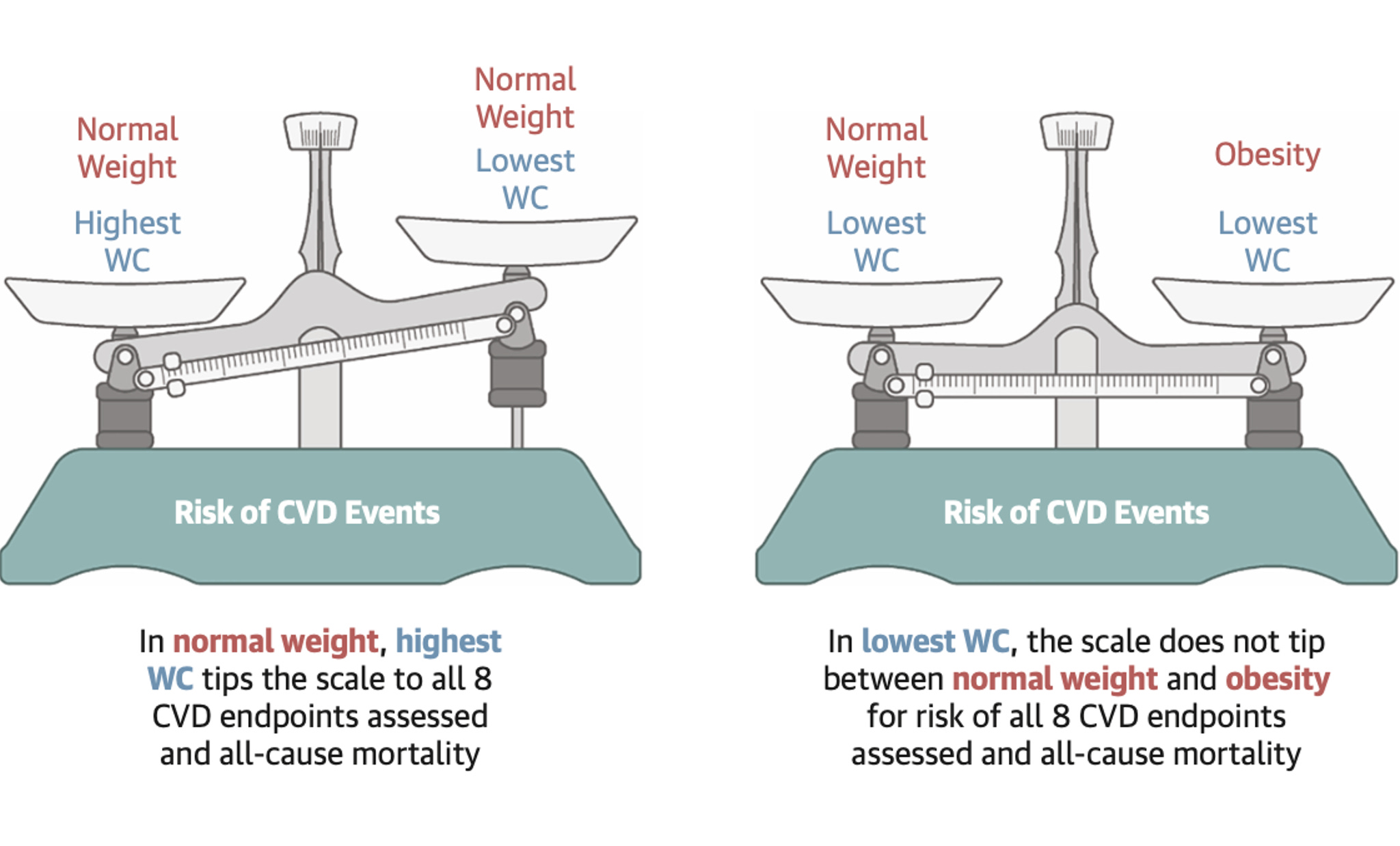
Dardari and colleagues concluded that adiposity metrics like WC and WHR are useful correctives for some of the limitations of BMI scores:
“Relying solely on BMI may result in misclassification of cardiovascular risk across a wide range of cardiovascular outcomes. We encourage clinicians to consider central adiposity distribution across the entire BMI spectrum when evaluating cardiovascular risk in primary prevention settings.”
3. When should a person consider themselves too heavy?
I’m persuaded by the new study, and by others, that when combined with the BMI, waist measurements can improve decision-making related to weight.
However, if you measure your BMI, WC, and WHR at home, I wouldn’t take the results too seriously. The risk estimates come from group data, but you’re not a group. Small measurement errors muddy the data somewhat. And, there’s no simple way to combine scores on two or three of these metrics and obtain fine-tuned guidance.
At best, consistencies across these metrics might reinforce something you already suspect about your weight (though you should remain open to the possibility that all three are wrong). Discrepancies might be useful too. A normal BMI but high WC hints that the BMI score is failing to register unhealthy amounts of adiposity. A BMI in the overweight or obese range, combined with low WC and WHR, suggests that you should seek more information but not assume the worst.
Goodhart’s law
If you do use these metrics, what you – and your health care provider – should avoid is a famous shift in priorities described by economist Charles Goodhart. Goodhart’s law is typically paraphrased like this:
“When a measure becomes a target, it ceases to be a good measure.”
State-mandated achievement tests are often cited as an illustration. The purpose of these tests is to measure how well students have mastered the curriculum. Scoring well on an achievement test is not the “target” of education.
However, districts, schools, and teachers are incentivized to boost achievement test scores. Teachers may “teach to the test”, thereby diverting attention away from learning curricular material.
To the extent that this occurs, achievement test scores only tell us how well students can perform on achievement tests. The tests thereby cease to be good measures of learning.
Here’s a more concrete example: Suppose you have mild hypertension and you’re aiming to improve. Would you drink several glasses of wine before measuring your blood pressure?
Of course not. Drinking temporarily lowers blood pressure, but the goal of measuring it isn’t to obtain a good score by any means, but rather to have a snapshot of your actual blood pressure. If you drink beforehand, you’ve let the measure become your target, and, as per Goodhart’s law, it’s no longer a good measure.
Going back to my original question (“When should a person consider themselves too heavy?”), part of the answer might be to consider BMI along with one or both of the waist measurements, but even in conjunction they’re far from perfect as estimates of adiposity. By relying on them too heavily we would fall prey to Goodhart’s law.
That is, the point of these metrics is to get a sense of whether a person’s visceral adiposity is problematic. The target of any intervention, formal or informal, would be to reduce adiposity and improve other aspects of health, not to change the metric values per se.
I used no AI for this newsletter except to see how a few of the chatbots would handle my original question. ChatGPT and AI Overview overemphasized the BMI, but in that respect they’re no worse than what you’d find on, say, web pages from Harvard Medical School, Cleveland Clinic, or Medline Plus, three of my top hits when googling the topic (and, I assume, written by humans):
Harvard: “If your BMI is above 25, losing weight is a smart idea.”
Cleveland Clinic: “A BMI of 25 or more means you have (sic) overweight.”
Medline Plus: “A good way to decide if your weight is healthy for your height is to figure out your body mass index (BMI).”
I believe that Claude AI, after some initial fumbling around, offered better advice:
“The most reliable way to know is a conversation with a doctor, who can look at your whole picture...rather than just a number.”
Though I dislike agreeing with AI, I do think that the best way to know whether you’re too heavy would be to consult with a medical professional about your labs, your medical history, your day-to-day experiences, and so on. The whole is greater than the sum of a few metrics.
Thanks for reading!
Well Ken, another good job. Interesting that I was looking this in Medscape: https://www.medscape.com/viewarticle/waist-circumference-and-waist-hip-ratio-may-reclassify-2026a1000rzv?ecd=mdedge_sum. Going to be shared in next posting. A shorter but good summary the study. However, give you a shout out, I have a couple of other items in this area as well. Still, BMI does not want to go quietly into the night. About the BMI table you posted, overweight is 25- 25.9 and >30 obese. Is it pre-obese between 25.9 and 30? (Yes, I was being snarky ;~)) I believe it's 29.9 and obese is 30 with 3 obese classes beyond that.
You touched on an annoying thing for me, when they are stuck on BMI at the clinic. I have touched on the changing measures for body fat and did so in Revisiting BMI & Obesity
New obesity definition sidelines BMI to focus on health
Fresh approach to diagnosing the condition looks at how excess body fat affects the
body.
https://jkd0811.substack.com/p/one-flew-over-the-petri-dish
Amid the rising buzz around Ozempic and similar weight-loss drugs, a group of 58
researchers is challenging the way obesity is defined and diagnosed, arguing that
current methods fail to capture the complexity of the condition. They ffer a more
nuanced approach.
The group’s revised definition, published in The Lancet Diabetes & Endocrinology1
14 January, focuses on how excess body fat, a measure called adiposity, affects the
body, rather than relying only on body mass index (BMI), which links a person’s
weight to their height. They propose two categories: preclinical obesity, when a
person has extra body fat but their organs work normally, and clinical obesity, when
excess fat harms the body’s organs and tissues.
This really captured the complexity of obesity and a new nuanced approach to the real
health aspects of adiposity.